A chainmaille flower tutorial

For both myself, and others. Also on Instructables.

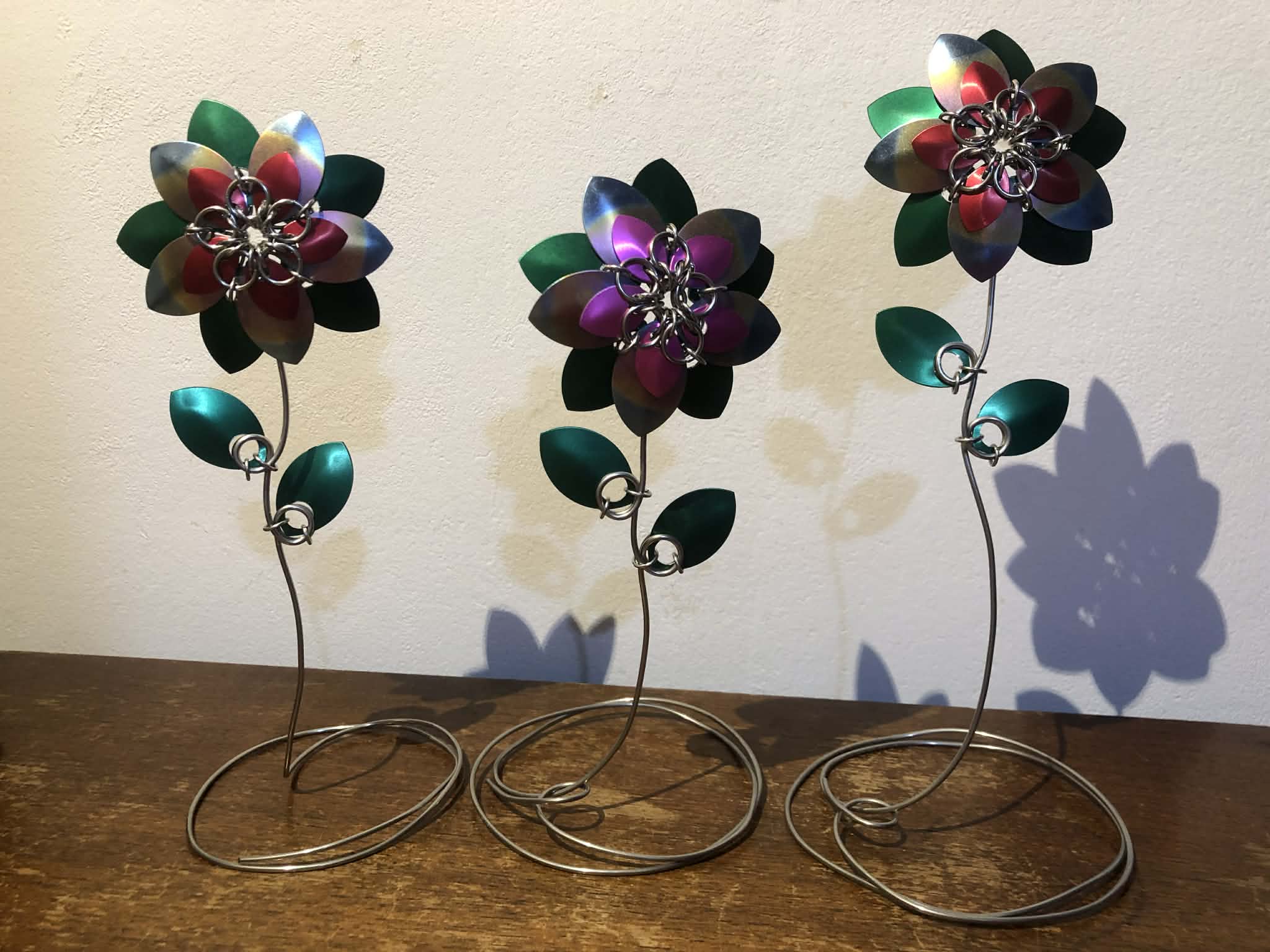
Three chainmaille flowers, created as a five petal chainmaille flower, made using large and small scales for the petals, large green scales behind the flower and as leaves down the stem. Awright, let's make a tutorial for that flower. Everyone that I've shown it to has raved over it, and I could absolutely see me selling these at some point in the shop. It's actually not too complicated to make... so let's make a tutorial! For both myself, and also for others looking to make the same, since very few free chainmaille tutorials seem to exist lately. And I want to let creators create without an entrance fee, so here ya go!
Three chainmaille flowers in a row, two with red petals and one with pink petals, with slightly different heights, standing on a wooden table.


Supplies needed:
First up, you will need the following:

In American sizes: In English sizes:
5 large scales of any colour
5 small scales of any colour
7 large scales green for leaves

10 x 16 gauge SWG 3/8" inner diameter rings
1  x 16ga 1/4" ring
20 x 18ga 1/4" rings
    OR 15 x 18ga 1/4" rings
    AND 5 x 18ga 15/64" rings
5 x 18ga 3/8" rings
1  x 12ga 1.5" support ring (optional)
2 more 18ga 1/4" rings for the leaves
2 x 18ga 3/16" rings for the leaves
And finally 40" of full soft 12ga wire
5 large scales of any colour
5 small scales of any colour
7 large scales green for leaves

10 x 1.3mm wire 10.2mm inner diameter rings
1  x 1.3x6.4mm ring
20 x 1.0x6.4mm rings
    OR 15 x 1.0x6.4mm rings
    AND 5 x 1.0x6.0mm rings
5 x 1.0x10.2mm rings
1  x 2.0x38mm support ring (optional)
2 more 1.0x6.4mm rings for the leaves
2 x 1.0x5mm rings for the leaves
And finally 1 meter of full soft 2.0mm wire

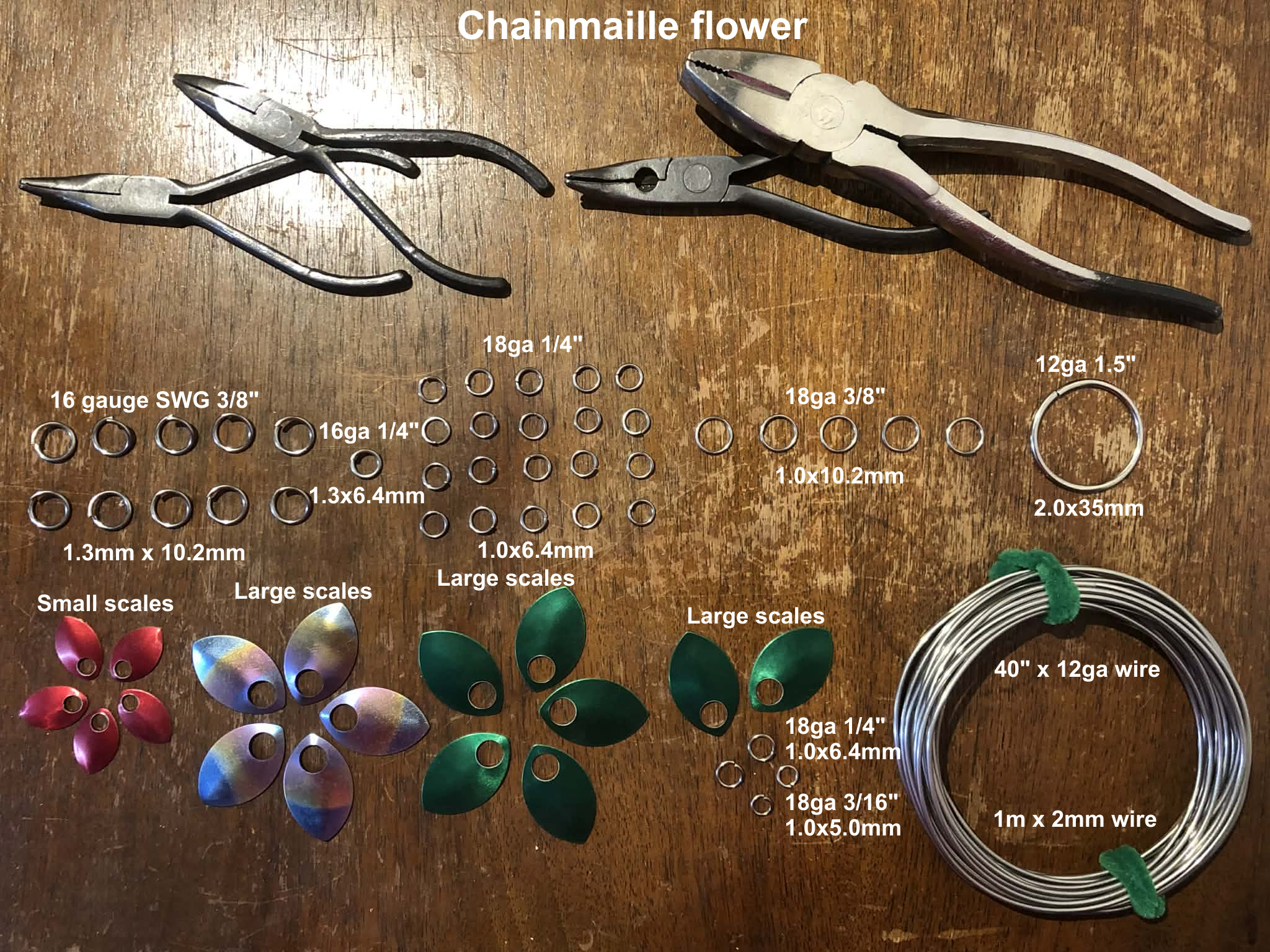
Collect all your supplies, pick a plier, any plier, any plier you desire! I prefer bent nose needlenose type, but it's up to you. I'll be typing the instructions in SWG format though, since that's what I've been familiar with for decades, and it makes sense in my head. Here's a photo with both sizes though that you can save to keep track of everything needed in one convenient pic.

Two sets of pliers, along with neatly arranged rings of various sizes on a wooden table, each labelled with text saying their sizes in both american and european size measurements.


Step 1:
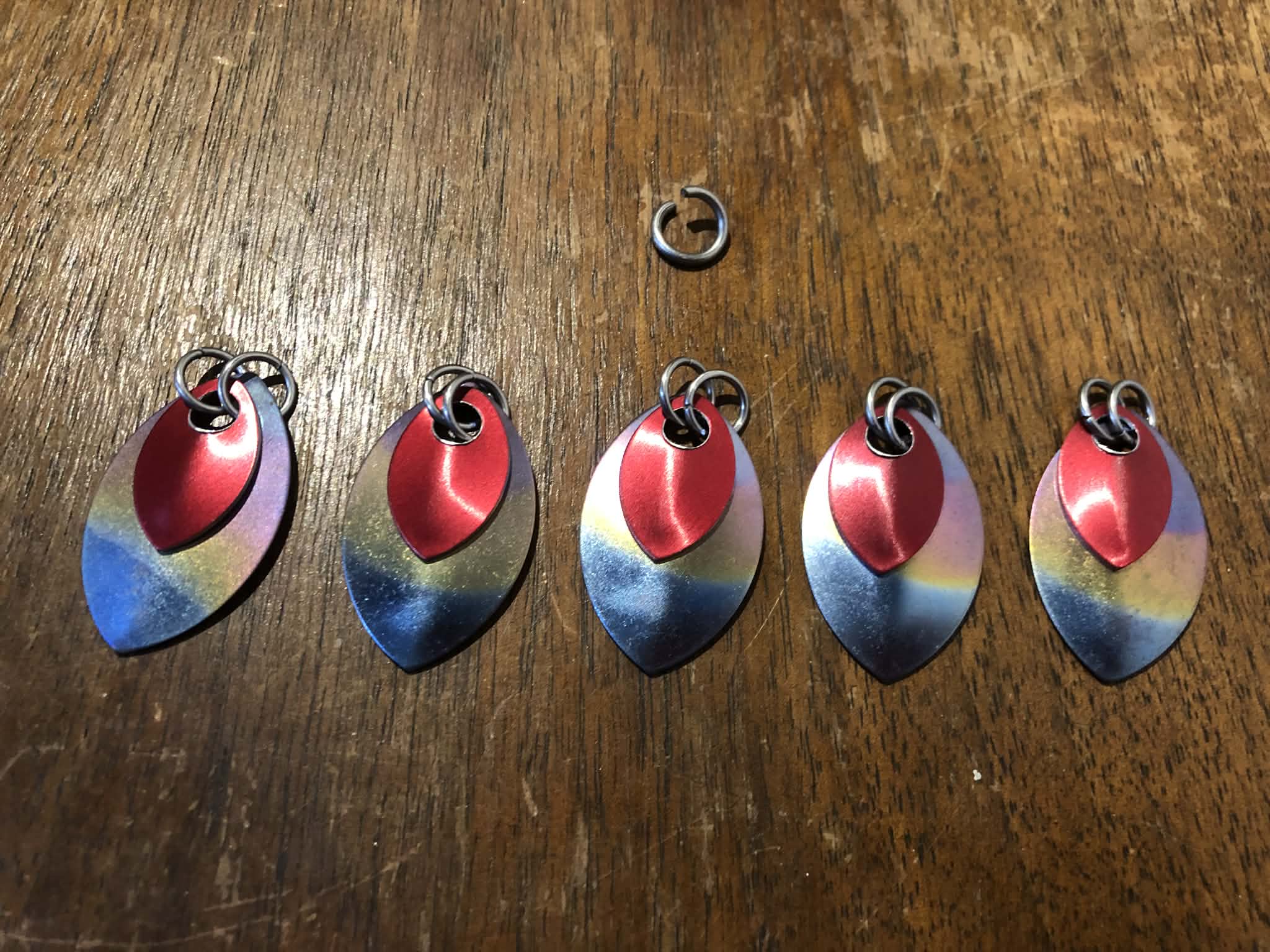
Layer the small petal scales over the large petal scales, and attach each of them with two 18ga 1/4" rings each.

Five sets of scales, the large rainbow scales with the small red scales laying on top of them, the two of them connected with two rings each.


Step 2:
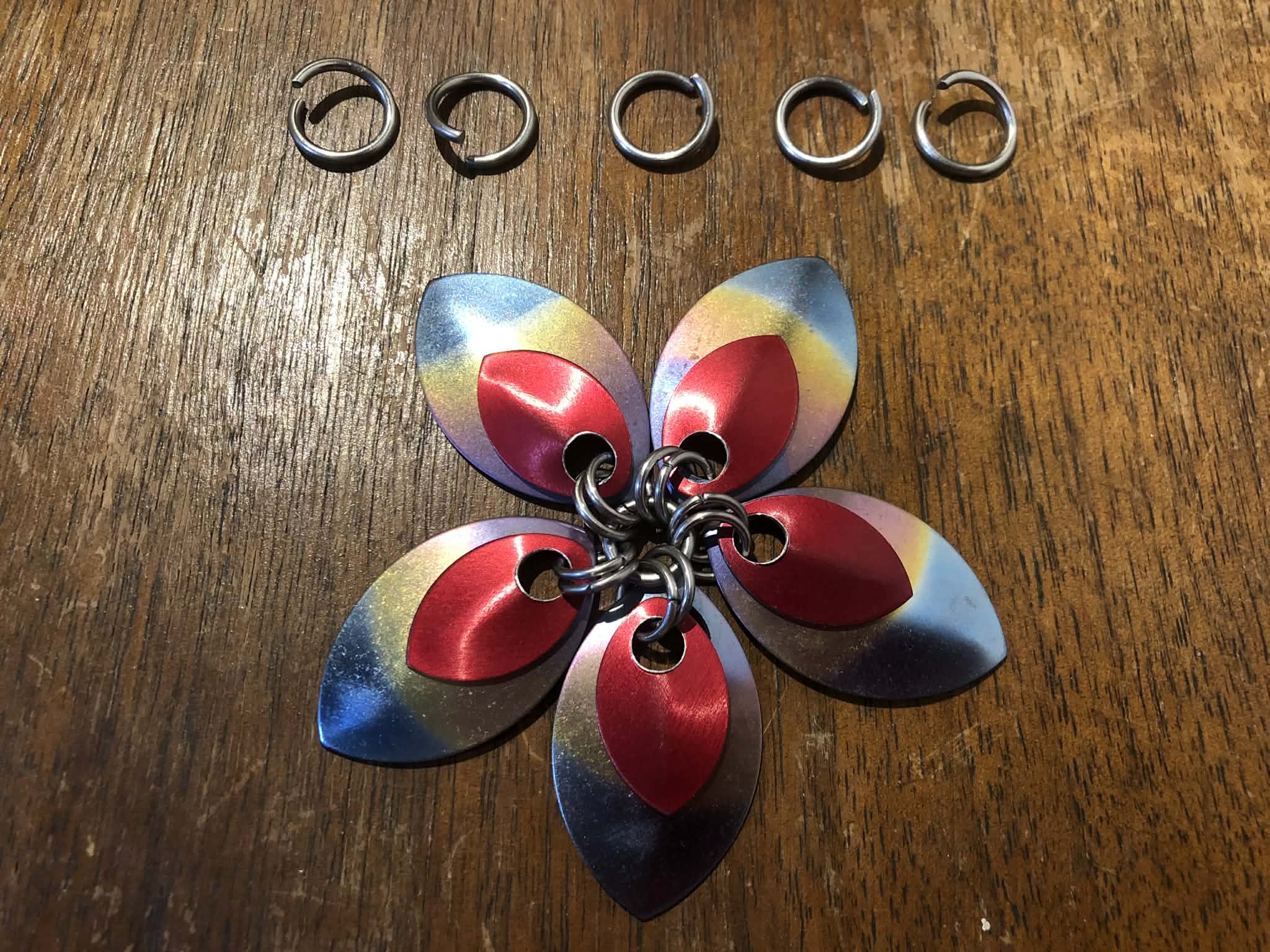
Put the one 16ga 1/4" ring through each of those 18 gauge rings to become the center of the flower.

The five double scale petals arranged in a star pattern, connected by a central ring through all of the others.


Step 3:
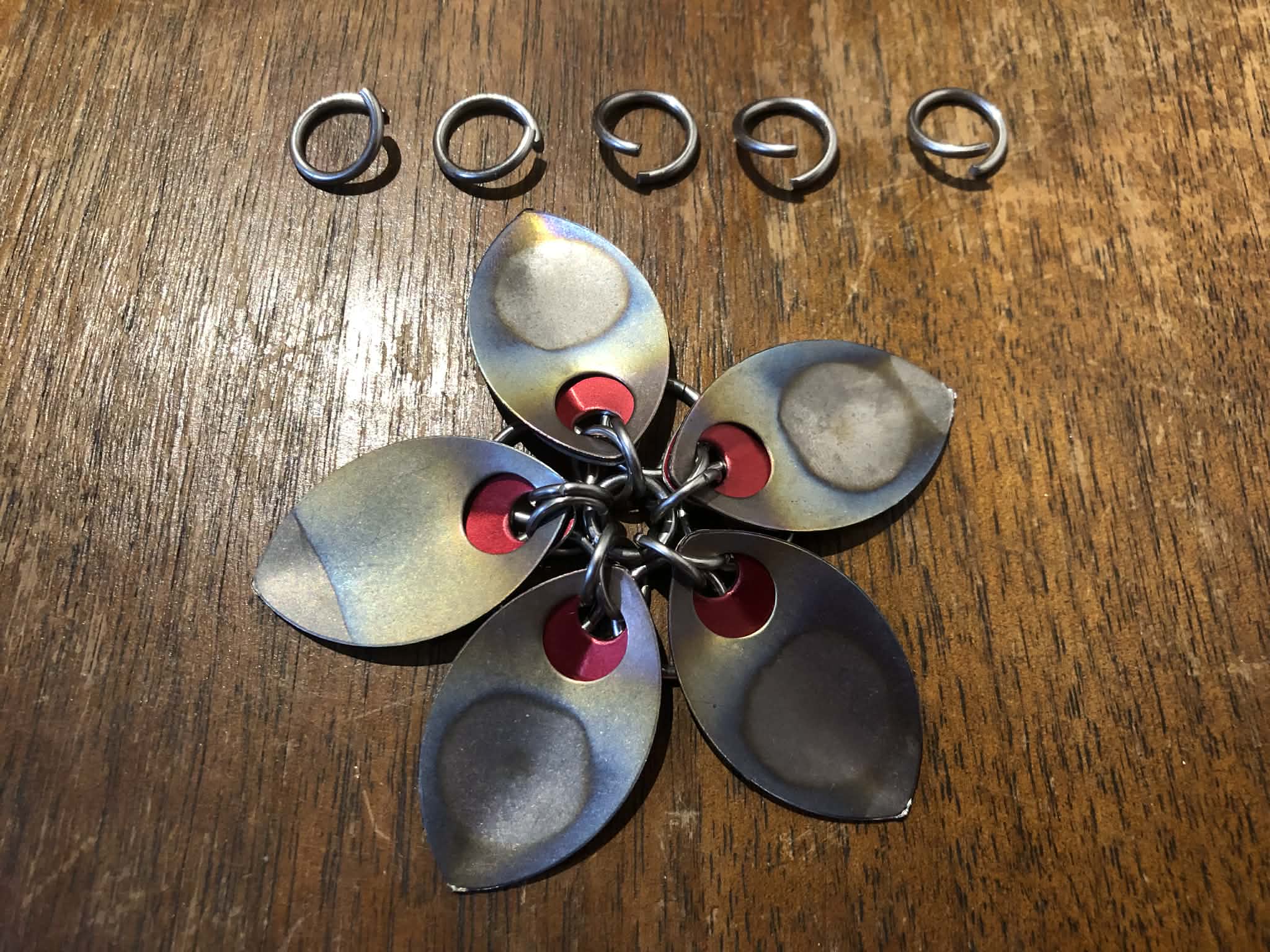
Attach the 16ga 3/8" rings through two 1/4" rings each from the front of the petals, making sure to get one ring each from two adjacent petals.

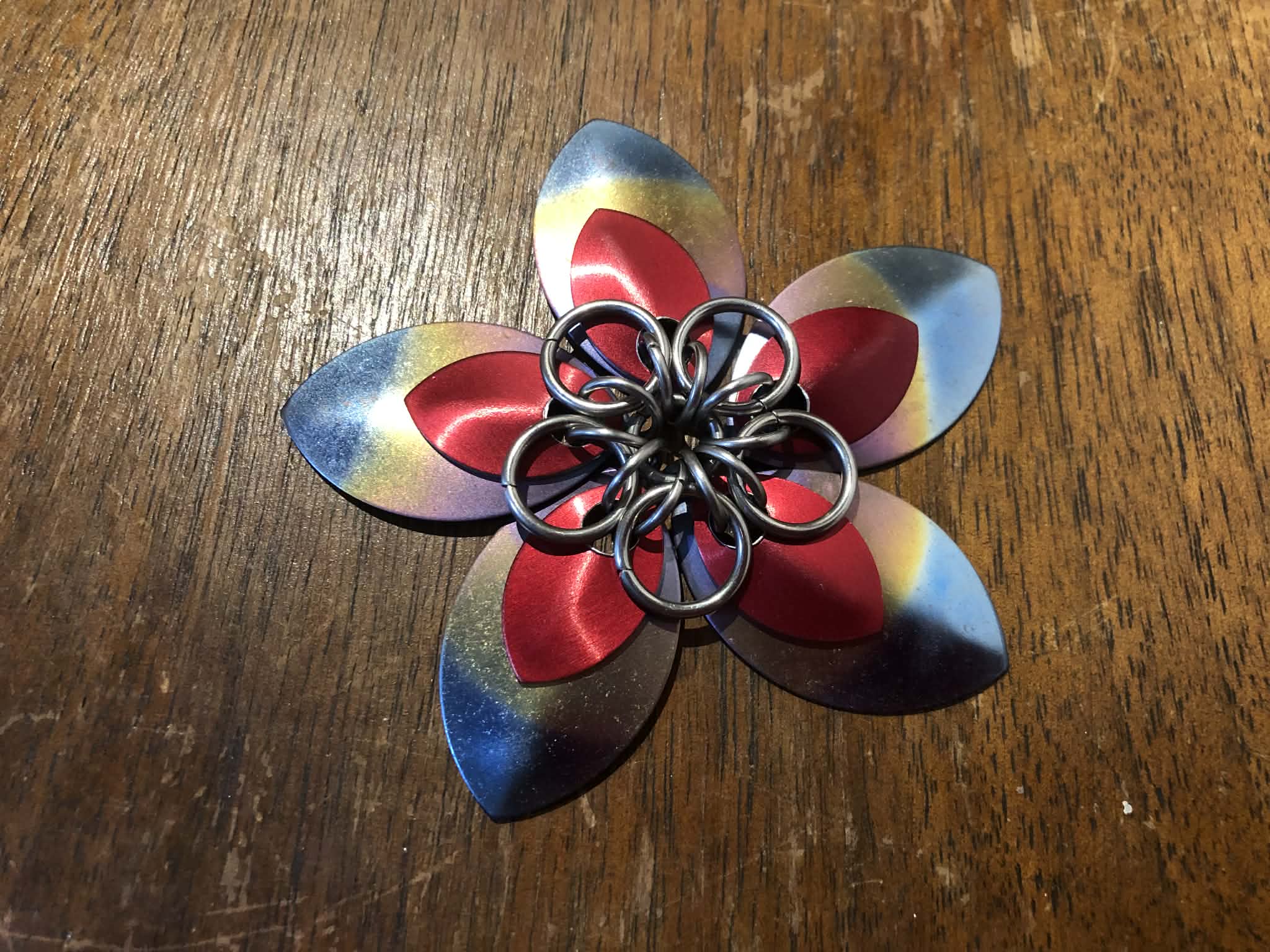
The star shape better secured in shape with five larger rings connecting adjacent scales together with one of their smaller rings each.


Step 4:
Flip it over.

The back of the star, showing that the scale petals are not yet connected together back here yet. Five more larger rings are sitting above the star ready to be added.


Step 5:
Attach the remaining 16ga 3/8" rings in the same way, going through one 1/4" ring each from adjacent petals.

The backs of the petals connected to eachother in the same way as in the front. Five green scales and five smaller rings are above to indicate the next step.


Step 6:
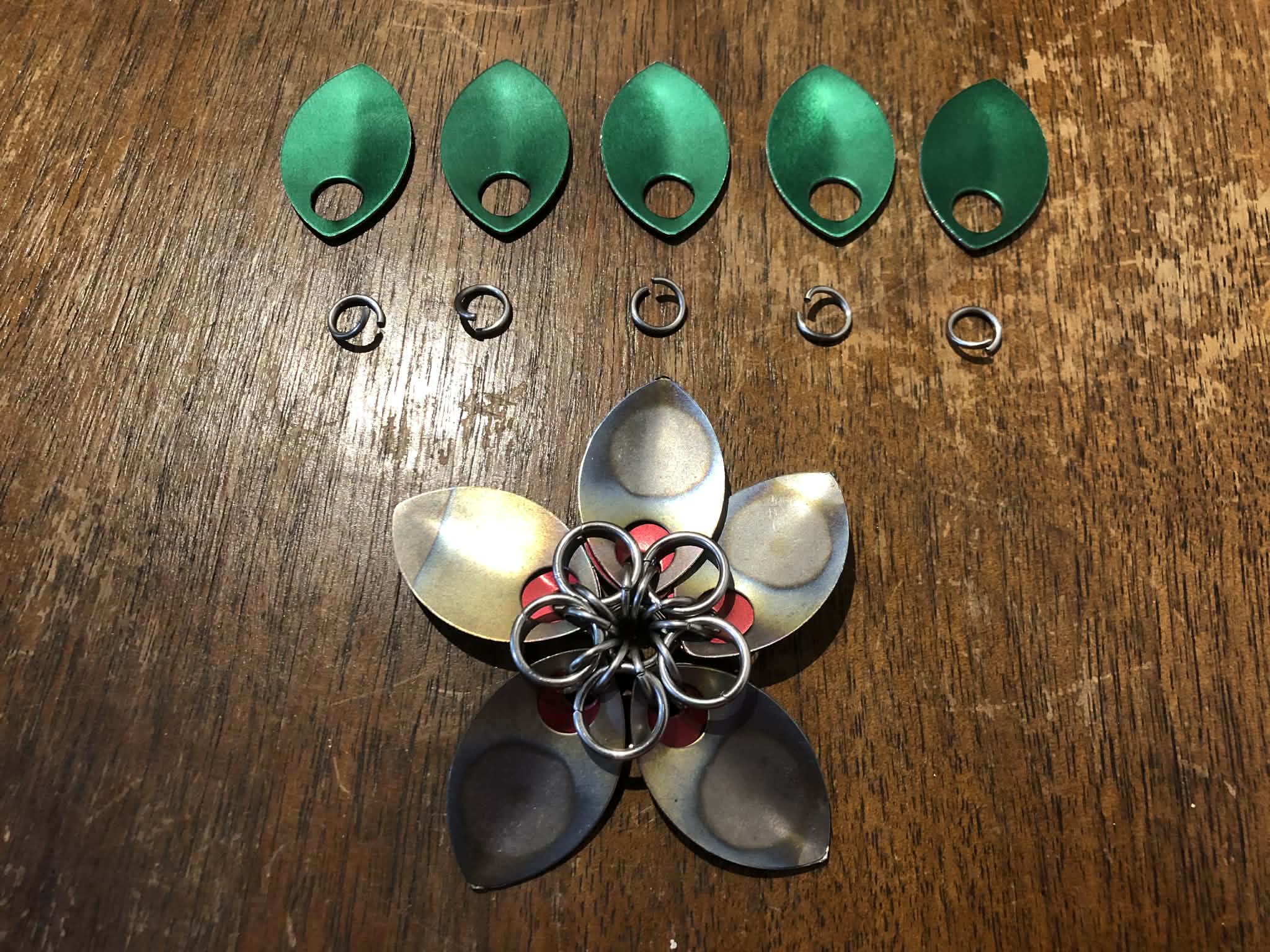
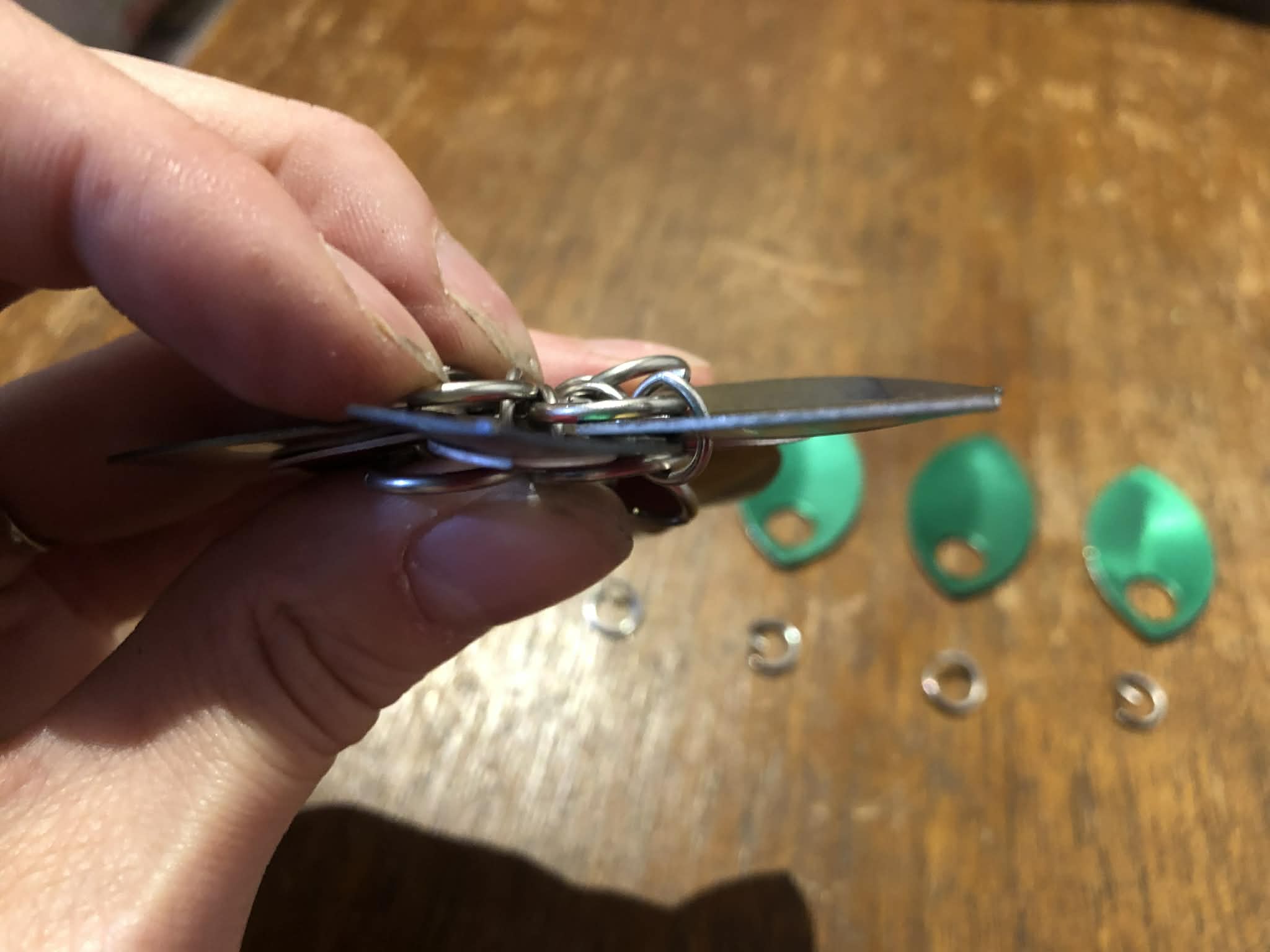
Here's where it gets tricky, and where you would bring in the 18ga 15/64" (1.0x6.0mm) rings if they're available. 1/4" rings will be a bit of a friction fit inside the punched holes of the scales, but it's still possible (they can be ovalled slightly too if you need). You want to put a ring around one of the front 3/8" rings, have it go through the hole of the green scale, and then go around the 3/8" ring on the back, sandwiching the green scale in place.

A side view of the green scale being added, with a smaller ring connecting the front and back larger rings, while going fully through the hole of the green scale.


Step 7:
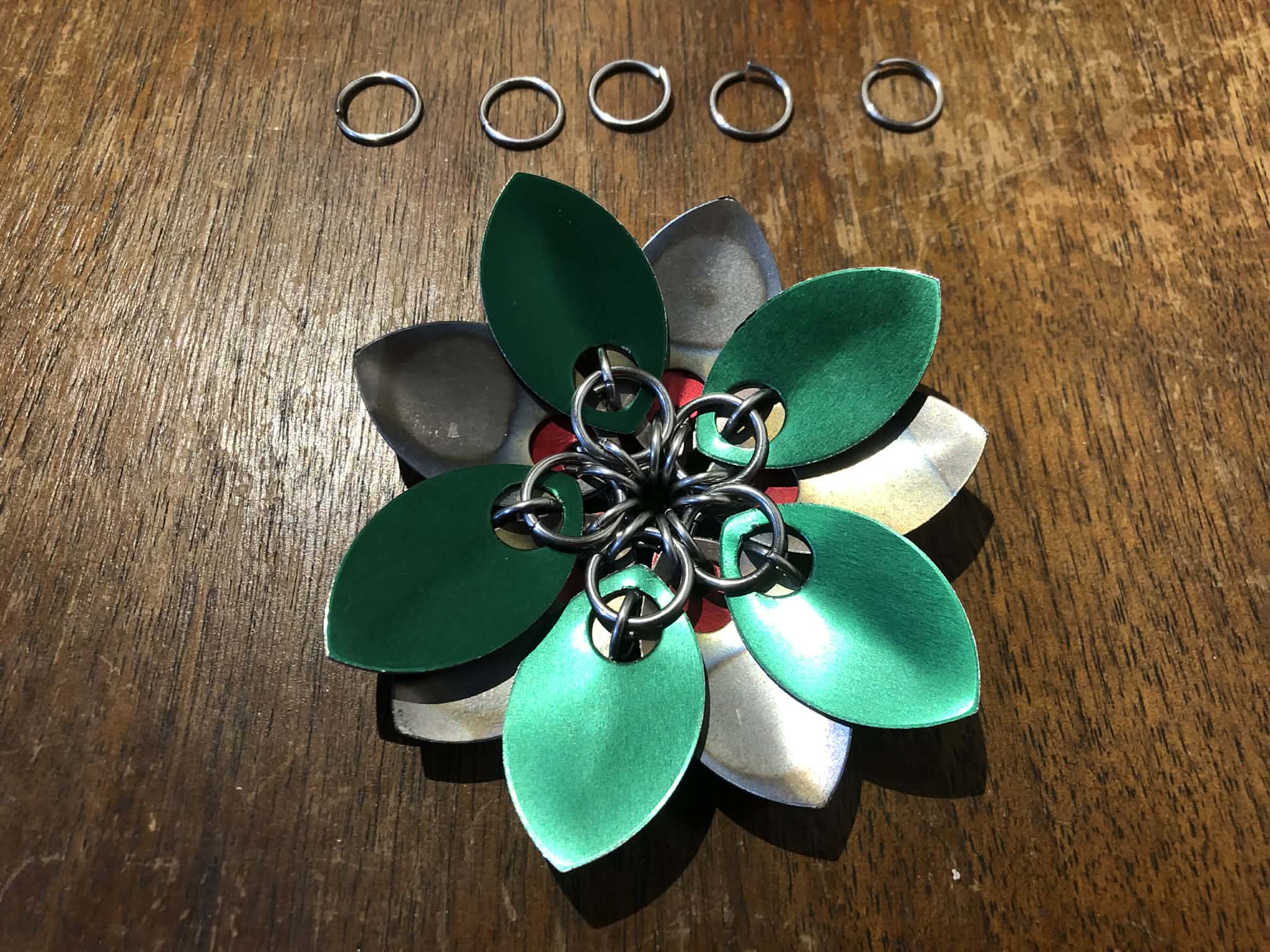
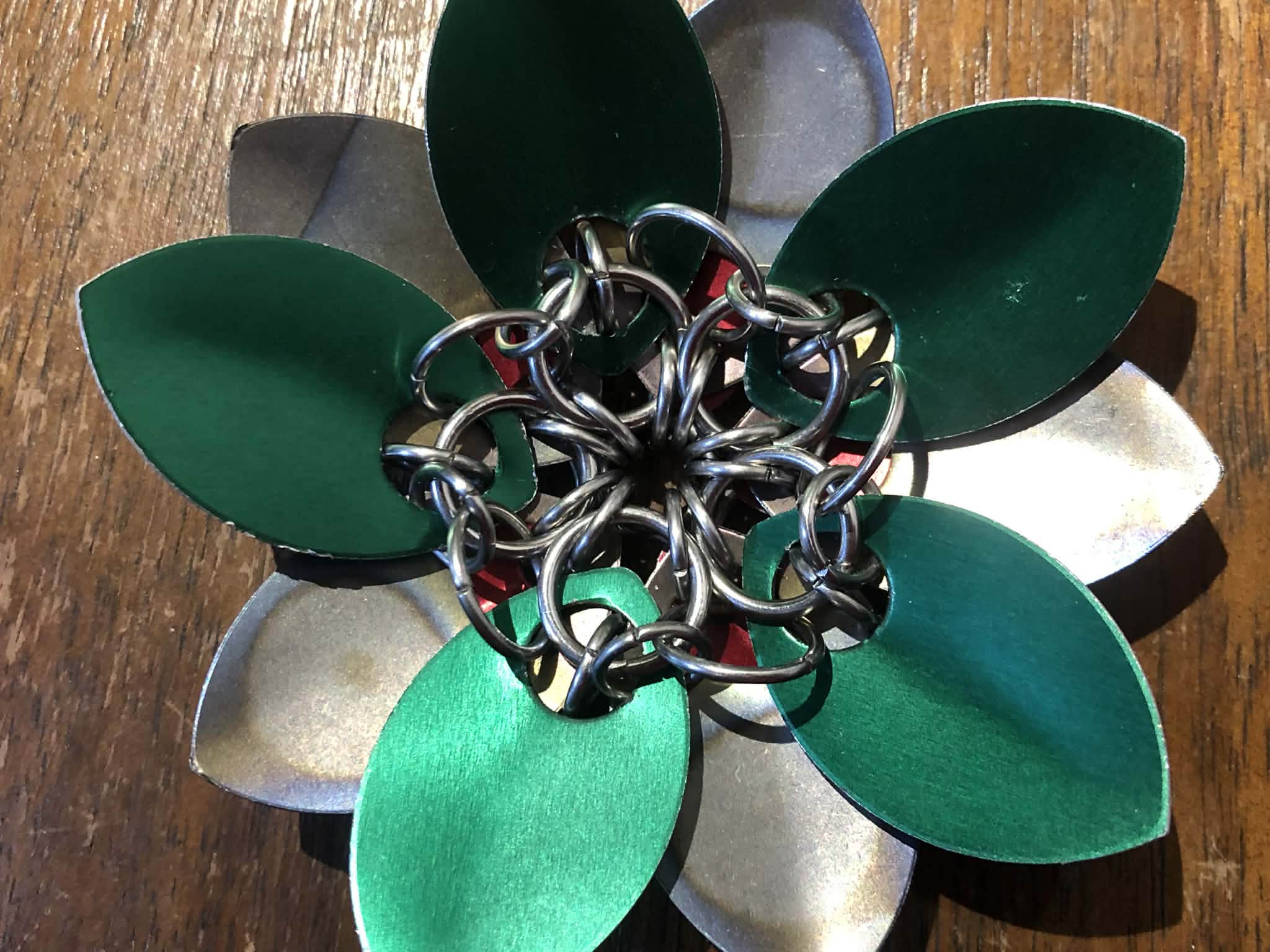
It should look like this. The next step might be a liiiittle bit trial-and-error, depending on how ever so slightly different one batch of rings is from the next, but our goal will be to secure the green scales in place to keep them from swinging side to side, while also creating a way to attach the stem.

The back of the flower, now with the green scales connected, effectively making a ten pointed star. Five thinner large rings for the next step are above.


Step 8:
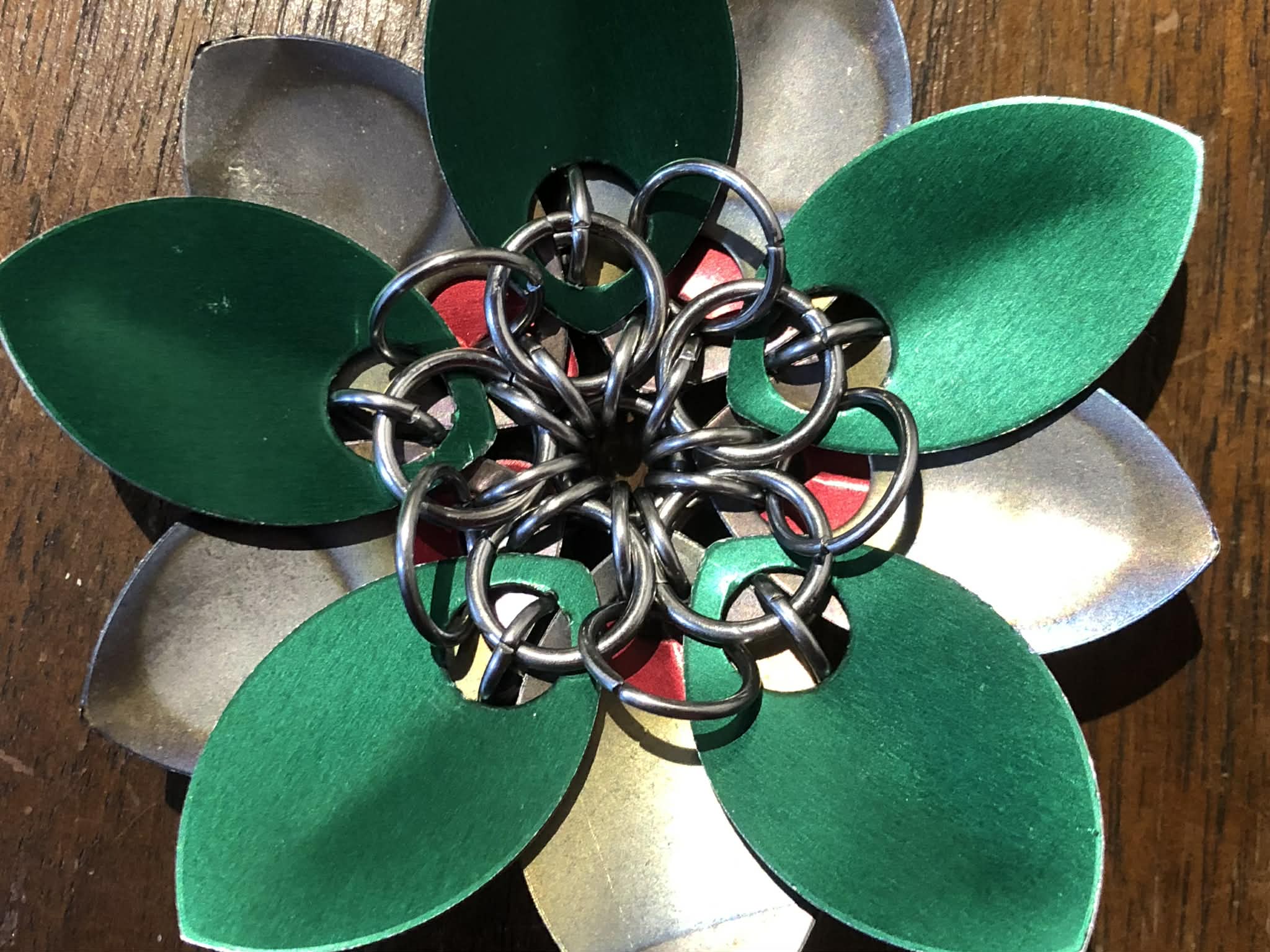
For this ring batch, I found that attaching an 18ga 3/8" ring around one side of the green scale, then through the adjacent side of the 16ga 3/8" ring works to tighten up the green scales somewhat. You may need to experiment here, but this worked for these flowers.

A closer view of the back, showing the thinner large rings going through one side of the green scale hole, and connecting it to the adjacent thicker large rings on the back.


Step 9:
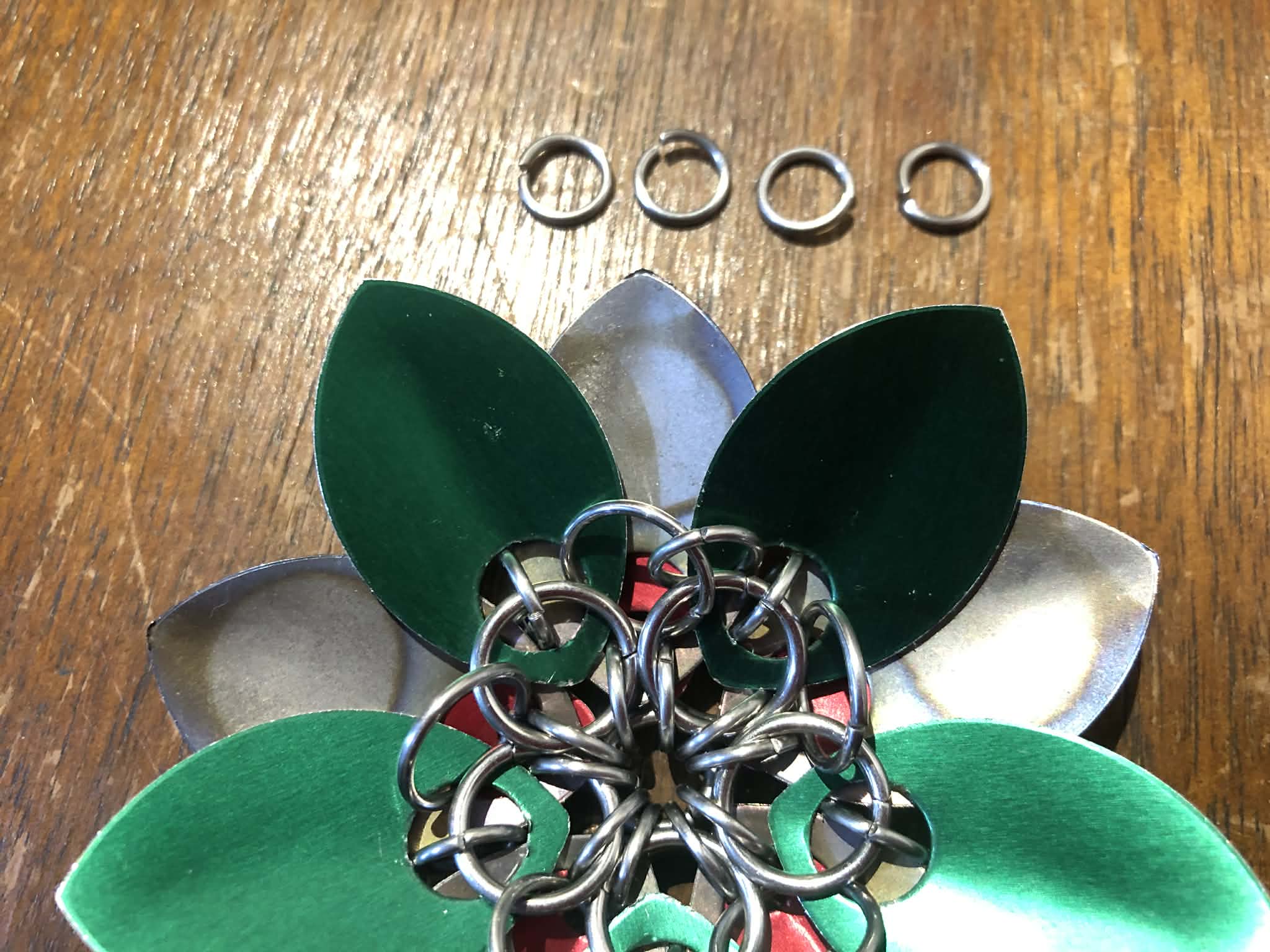
At this point, I found it best to attach the other side of the green scale to that 18ga 3/8" ring from the last step, and while loose, will make a wonderful size for the stem to go through. I've also used five more 18ga 3/8" rings instead of the 1/4" here, which allowed me to place both the support ring AND the stem through, though it's a bit messier looking from the back.

Another closer view showing a smaller ring connecting the previous thinner large ring and the previously unconnected side of the green scale.


Step 10:
Here's what it looks like with all of the green scale support rings added.

Just a photo of the last step having been finished for all five rings, each green scale now being connected to a ring on both sides.


Step 11:
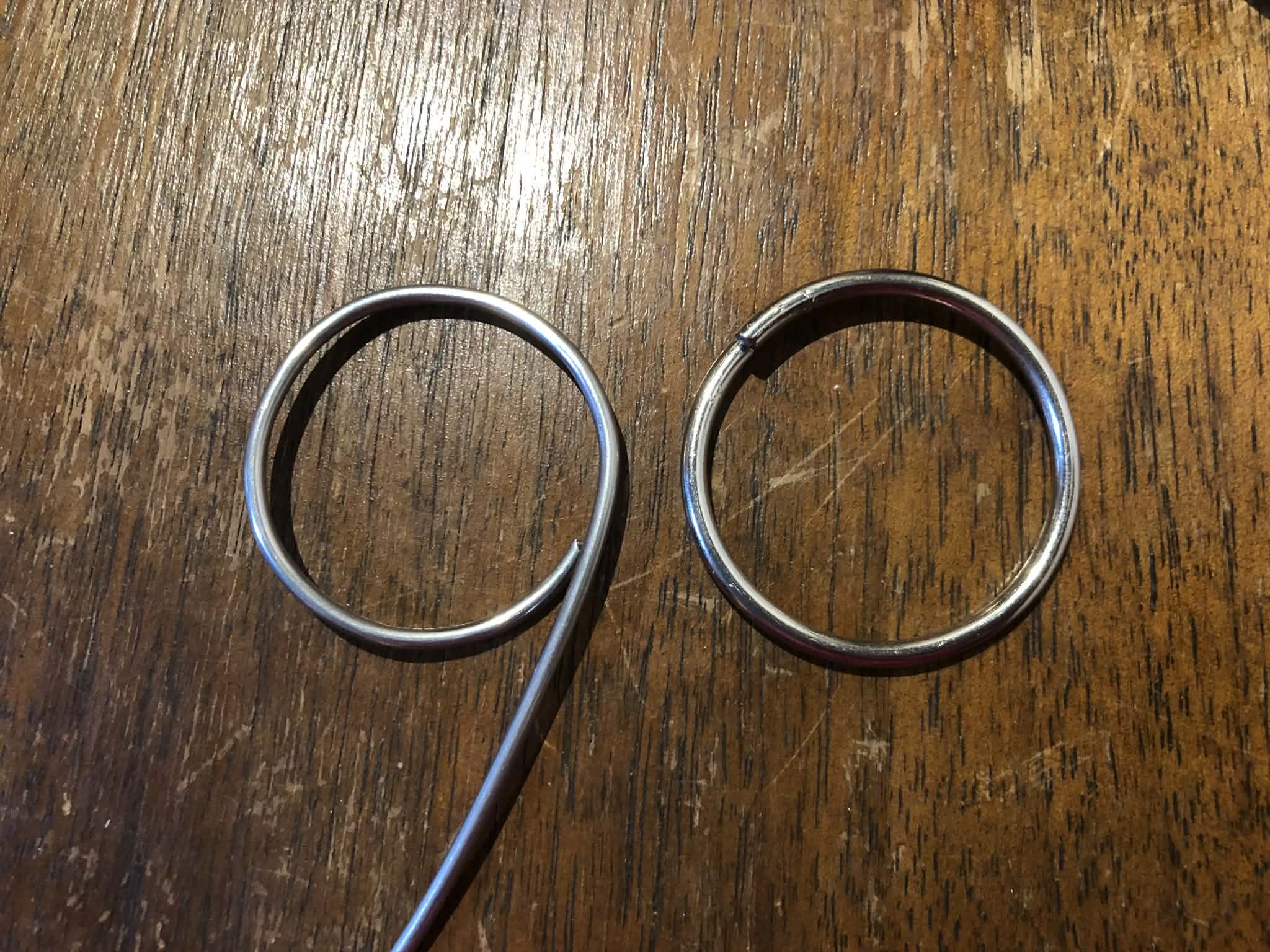
Now is when, if you don't want a stem, you can just open the support ring to prepare, or take your stem wire and coil the end to as close to the same size as the 1.5" support ring as possible. Make it as round as you can.

The thick stem wire creating a loop at the end approximately the same size as the large support ring, interestingly looking like the number 90 on the table.


Step 12:
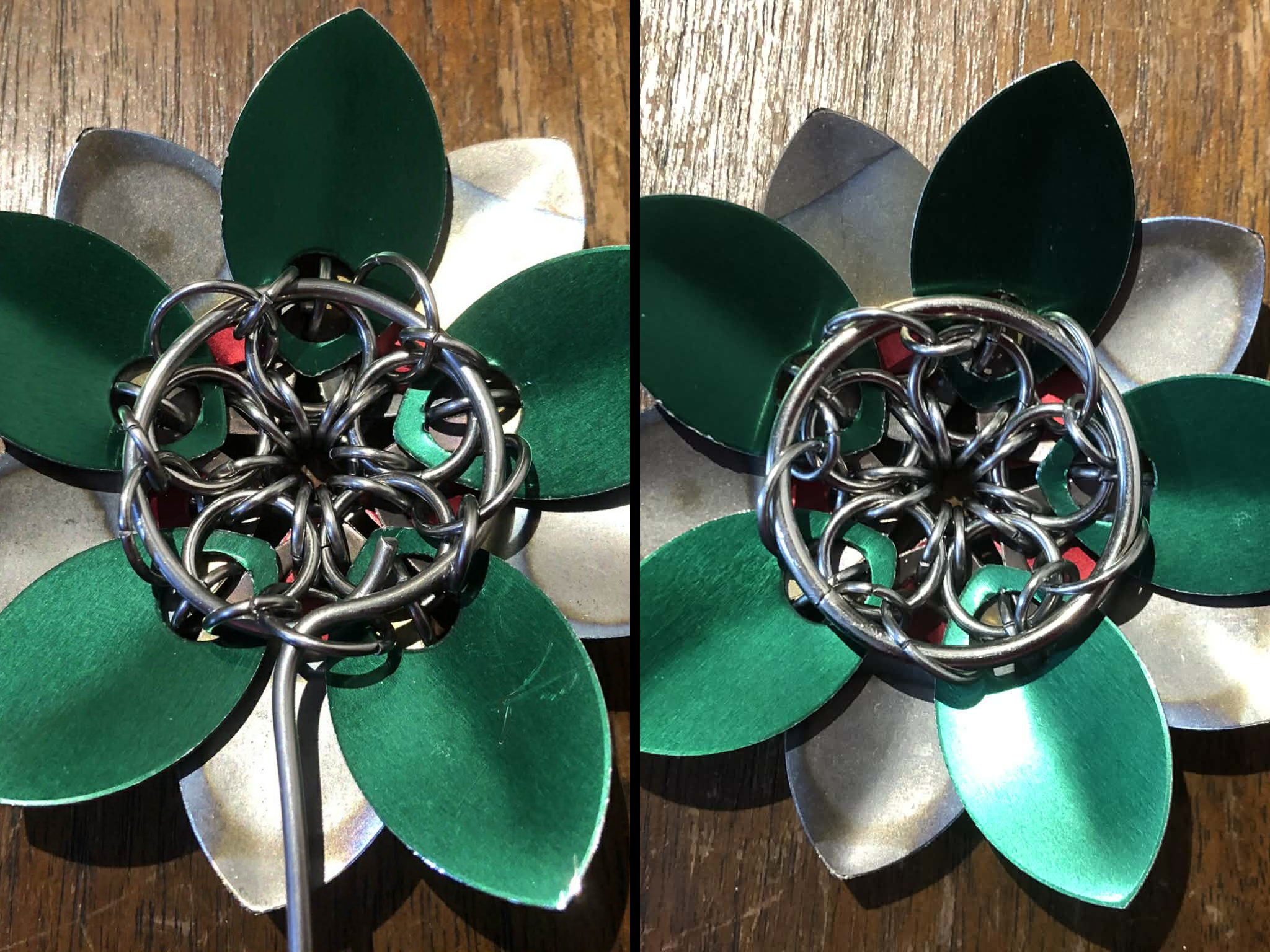
Here is the comparison between the two, and definitely why you want full soft (dead soft) wire, because once you weave that wire through the rings that you can, you need to bend the tip of the wire inwards to keep it from turning off, and bend the remainder of the wire downwards for the stem. You can also re-open and close the bottom 18ga 3/8" ring to slip the downstem through, and go through the 1/4" rings or not if you like, whichever option works out for you. As long as it keeps the flower open, and stops it from folding itself backwards.

A two part image, the left side showing the back with the stem ring added, and further being bent down at the center to lead to the rest of the stem, and the right side showing the support ring doing much the same, but with no downstem.


Step 13:
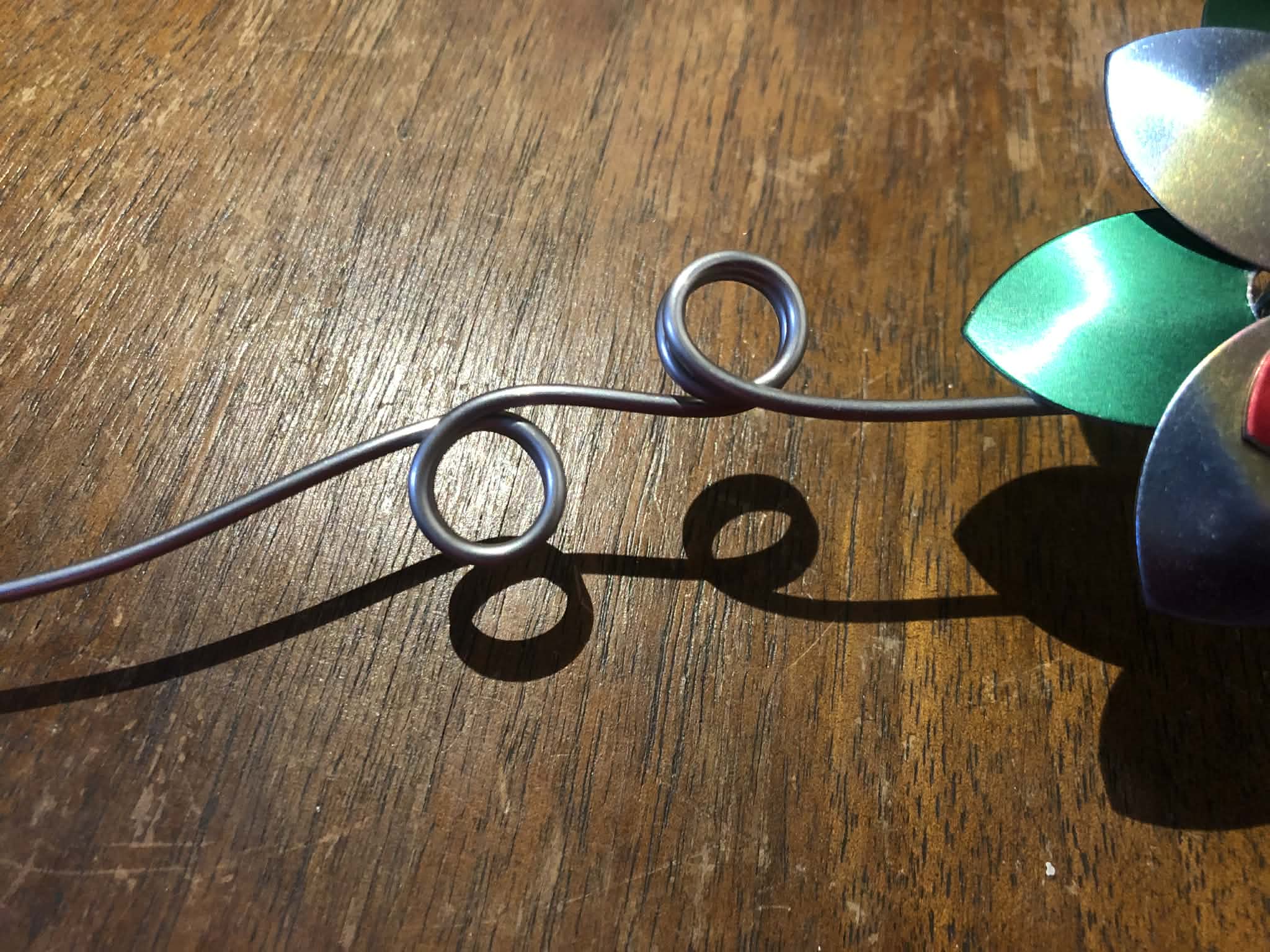
Now you get to decide where you want your stem leaves! Make a double-loop in the stem anywhere and in any direction that you want a leaf to be, just don't clip the wire from the main spool if you want to make more than two leaves. The 1 meter estimate accounts for two leaves in the stem.

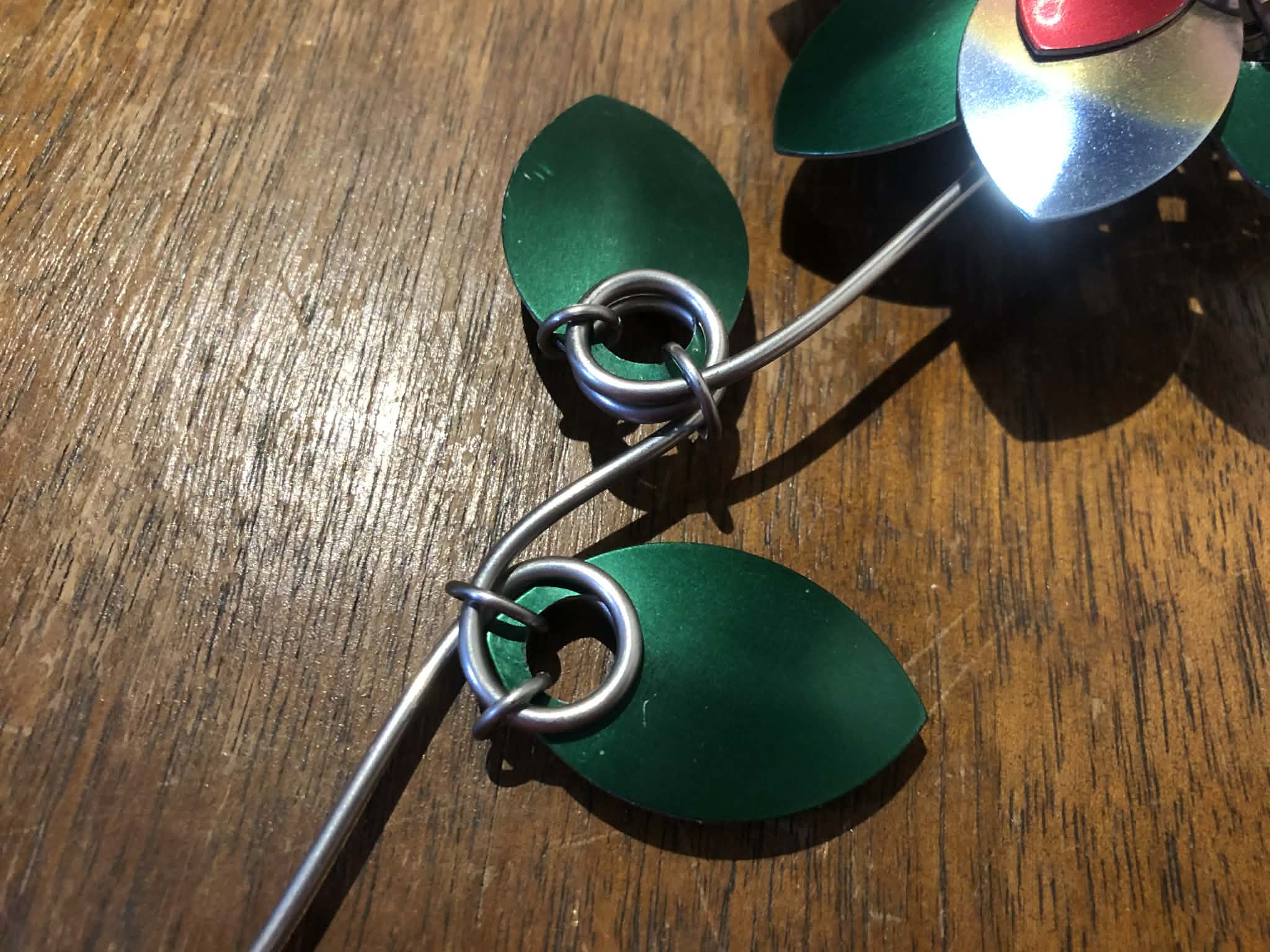
A gentle curve of the stem wire leading up to the flower, doing a coil to the right for a lower leaf, then to the left for an upper leaf, before reaching the flower head.


Step 14:
Open up the double-loop slightly so you can slip the leaf scale inbetween, and put an 18ga 1/4" ring through the scale hole where it's closest to where the stem wire is tripled, and the 18ga 3/16" ring on the other side of the scale at the bottom of the double-loop. The leaf can still be moved of course, but the double-loop can be squeezed to hold it in place.

Green scales added between the coils in the stem and attached with two rings each to keep them in place, reaching out toward either side of the flower.


Step 15:
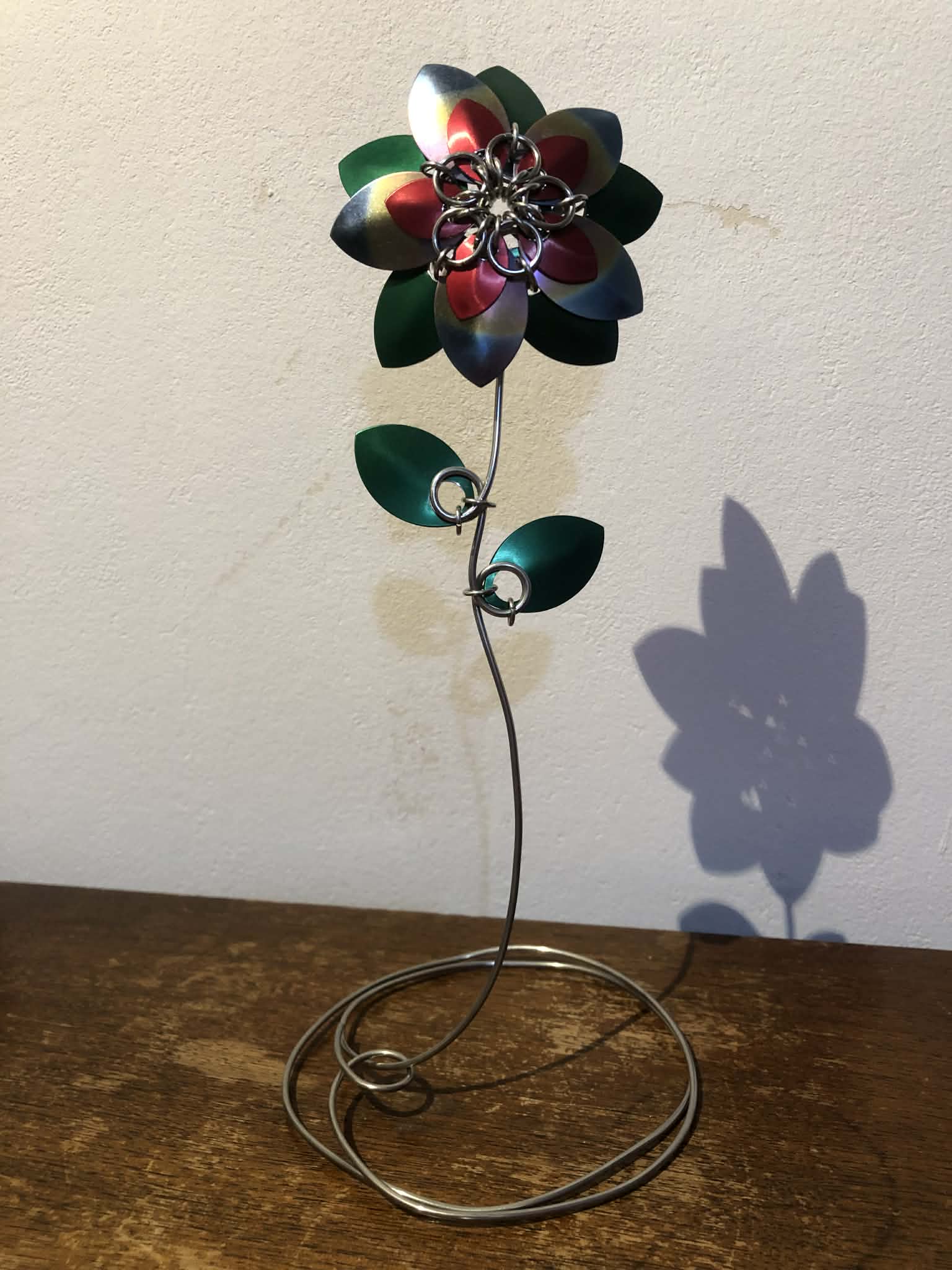
And finally, gently curve off the stem into the base stand, which will be a large double-loop, and make a smaller loop at the very end around the bottom of the stem before ending it elegantly back into the base. You can spend as much time as you want on this part, making it making it a custom shape, size, wrap a fabric tape around it, brown or green pipe cleaners to simulate earth, however you like. It's the home stretch, now is when you can tweak it as you may.

A full photo of the finished flower in front of a white wall on the wooden desk, its red and rainbow petals backed by green leaves, a gently curving stem with two leaves, leading down to a rounded base at the bottom. The completed chainmaille flower.


Full build time (for my third flower, taking trial and error out of the equation, but still mostly unpracticed), 51 minutes! About an hour if you include pulling out the rings. Pre-open all of them at the start to speed up the middle steps.

And that came out really nice! This started as a mostly trial-and-error build in flower 1, was refined a bit in flower 2, and time tested for flower 3. I only had those rainbow anodized titanium and (luckly) green for large scales, but of course use any colours of scales and rings that you like. I used stainless steel for all rings, as is my preference, but use any that you like! A full copper flower could certainly be interesting over time.

I hope that this tutorial was useful for you. I set out to make a birthday present for someone, and everyone raved about it so much, I felt the need to make an instruction sheet for it. Make them to your heart's content :D !


Back to chainmailling